





RAM Promaster vs Ford Transit Fleets Tallahassee FL Blog
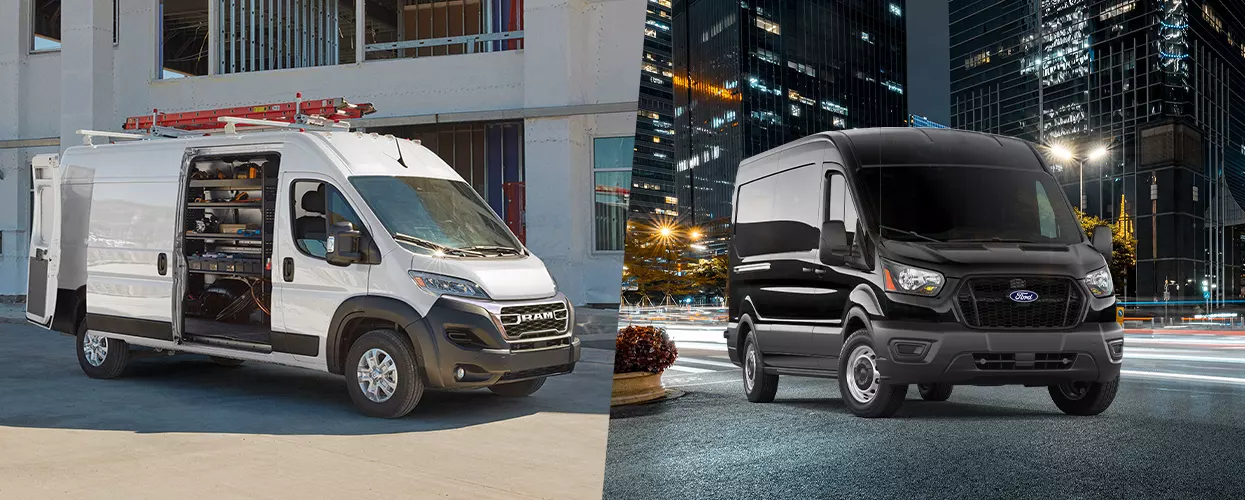
How Do RAM ProMaster Vans Compare to Ford Transit for Business Fleets?
The RAM ProMaster and Ford Transit are both capable full-size commercial vans, but they serve business fleets differently. ProMaster emphasizes front-wheel-drive maneuverability, a low load floor, broad cargo space, and strong available payload. Transit offers rear-wheel drive, available all-wheel drive, multiple engines, and extensive body configurations. At Tallahassee Chrysler Dodge Jeep RAM Fiat, we help businesses from Tallahassee, Bainbridge, and Bradfordville compare the features that affect daily productivity.
Which Commercial Van Is Better for a Business Fleet?
The better van depends on how the business operates.
The RAM ProMaster may be the stronger choice for companies that prioritize
- A low and wide cargo floor
- Front-wheel-drive traction
- Easy urban maneuvering
- Frequent loading and unloading
- High available payload
- Straightforward gasoline power
- Custom shelving and upfit flexibility
The Ford Transit may be better for fleets that need
- Available all-wheel drive
- Rear-wheel-drive capability
- A choice of two gasoline engines
- Passenger-van configurations
- Multiple gross vehicle weight ratings
- Greater drivetrain variety
- Specialized cutaway or chassis-cab applications
The 2026 RAM ProMaster offers up to 524 cubic feet of cargo room, a maximum available payload above 5,000 pounds in selected configurations, and multiple roof heights and body lengths. The Ford Transit provides low, medium, and high roofs, two cargo-van wheelbase lengths, rear-wheel drive, and available all-wheel drive.
Neither van is automatically best for every fleet. A delivery company working on tight city routes may value ProMaster’s loading height and front-wheel-drive packaging, while a business that travels on varied surfaces may prefer Transit’s available all-wheel drive.
How the RAM ProMaster Supports Delivery and Service Fleets
The ProMaster uses a front-wheel-drive layout. Because the drivetrain does not require a rear driveshaft running beneath the cargo area, RAM can provide a low load floor and wide interior space.
That design can help employees who repeatedly step in and out of the van during the workday. It may reduce lifting height when loading
- Packages
- Tools
- Plumbing equipment
- Electrical supplies
- Catering products
- Medical equipment
- Cleaning supplies
- Replacement parts
The ProMaster also has a relatively square cargo area that can make shelving, storage bins, partitions, and other upfits easier to plan.
RAM offers cargo vans in 1500, 2500, and 3500 series, along with different roof heights and cargo lengths. Selected versions provide up to approximately 13 feet of cargo-area length and as much as 524 cubic feet of available cargo space.
For businesses operating in downtown Tallahassee or making frequent neighborhood stops in Bradfordville, the ProMaster’s turning characteristics and front-wheel-drive layout can make it a practical mobile workspace.
How Ford Transit Provides More Drivetrain Variety
Ford Transit uses rear-wheel drive as its standard layout and offers intelligent all-wheel drive on selected configurations.
That flexibility may benefit fleets operating in
- Rural service areas
- Construction sites
- Unpaved parking areas
- Regions with changing road conditions
- Routes that extend beyond urban streets
Transit also offers two 3.5-liter V6 engines. The standard naturally aspirated V6 emphasizes straightforward operation, while the available EcoBoost V6 provides additional turbocharged performance.
By comparison, the 2026 ProMaster uses a 3.6-liter Pentastar V6 with a nine-speed automatic transmission and front-wheel drive across its lineup. RAM lists the engine at 276 horsepower.
Businesses that want one consistent powertrain across multiple fleet vehicles may appreciate ProMaster’s simplicity. Companies that need to configure vans for substantially different routes may prefer Transit’s drivetrain and engine choices.
Why Payload Must Be Compared by Configuration
Payload determines how much weight a van can carry, including the driver, passengers, shelving, tools, equipment, and cargo.
Selected ProMaster configurations can provide payload ratings above 5,000 pounds. RAM’s detailed specification pages list payload that can vary significantly based on body length, roof height, trim, and gross vehicle weight rating.
The 2026 Ford Transit also provides a wide range of payload ratings. Ford’s technical guide shows cargo-van payload figures ranging from roughly 3,000 pounds to more than 5,000 pounds in selected heavy-duty configurations.
Fleet managers should never compare only the highest published figures. An extended high-roof van with shelving and equipment may have less usable payload than a shorter, more basic version.
Always review
- Door-jamb payload label
- Gross vehicle weight rating
- Upfit weight
- Driver and passenger weight
- Typical cargo weight
- Roof-mounted equipment
- Towing requirements
Tallahassee Chrysler Dodge Jeep RAM Fiat can help businesses identify a ProMaster configuration based on the weight and volume the van will actually carry.
How Cargo Shape Affects Productivity
Cargo volume is useful, but the shape of the area often matters more than the total number.
A business should consider
- Distance between the wheel wells
- Interior standing height
- Rear-door opening
- Side-door width
- Floor height
- Wall shape
- Space needed for shelving
- Access to frequently used tools
ProMaster is known for its wide cargo floor and near-vertical side walls, which can make it easier to install shelving close to the body.
Transit offers multiple roof heights and body lengths, allowing fleet operators to prioritize standing room or overall cargo capacity. Its longer configurations may work well for businesses carrying large but lighter materials.
Before choosing, companies should map the intended layout. Draw the position of shelves, equipment, ladders, partitions, and walkways. This can reveal whether a smaller van with a more efficient interior is better than a larger van with unused space.
Why Upfitting Is Essential to the Decision
Most commercial vans are not complete work vehicles when they leave the factory. They may require specialized equipment such as
- Shelving
- Refrigeration
- Ladder racks
- Tool storage
- Flooring
- Partitions
- Electrical systems
- Mobile workstations
- Accessibility equipment
- Safety lighting
The ProMaster is designed to support a wide range of commercial conversions, including cargo, service, delivery, and mobile-work applications. RAM offers Cargo Van, Window Van, and Cutaway configurations to support different types of businesses.
Ford Transit also provides Cargo Van, Passenger Van, Chassis Cab, and Cutaway options.
Fleet managers should speak with the upfit provider before ordering the vehicle. The equipment may require a specific wheelbase, roof, payload rating, electrical system, or door layout.
How Warranty and Maintenance Affect Fleet Costs
Purchase price is only one part of commercial-vehicle cost. Downtime, maintenance intervals, warranty coverage, fuel, tires, and repair access can influence long-term fleet performance.
RAM promotes a 10-year or 100,000-mile limited powertrain warranty on selected 2026 RAM trucks and vans, along with a basic limited warranty and roadside assistance. Restrictions and coverage terms apply.
ProMaster also advertises up to 10,000 miles between oil changes under qualifying conditions, although actual service needs depend on vehicle use and onboard maintenance guidance.
Businesses should build maintenance around operating severity. Frequent idling, short trips, heavy payloads, extreme heat, and dusty worksites may require more frequent attention.
Expert Tips for Comparing Fleet Vans
Calculate cost per working mile rather than comparing purchase prices alone. Include financing, fuel, maintenance, insurance, upfit costs, expected resale, and downtime.
Test the van with employees who will use it. Drivers should evaluate seat comfort, visibility, turning radius, step-in height, mirror coverage, and camera systems.
Weigh the completed upfit whenever possible. Shelving and equipment reduce remaining payload before the first box or tool is loaded.
Standardize configurations when practical. Using the same van, shelves, tires, and parts across a fleet can simplify training and inventory.
Finally, consider where the van will be serviced. A commercial vehicle that cannot return to work quickly can cost more than a slightly more expensive model with convenient support.
Frequently Asked Questions About ProMaster and Transit
Is ProMaster easier to load?
Its front-wheel-drive layout allows a low cargo floor, which may make repeated loading and unloading easier.
Does ProMaster offer all-wheel drive?
No. The current ProMaster uses front-wheel drive. Ford Transit offers rear-wheel drive and available all-wheel drive.
Which van has more cargo space?
Maximum space depends on configuration. ProMaster offers up to 524 cubic feet, while Transit provides several body lengths and roof heights.
Where can businesses compare RAM ProMaster vans?
Visit Tallahassee Chrysler Dodge Jeep RAM Fiat in Tallahassee, FL. We help businesses from Tallahassee, Bainbridge, GA, and Bradfordville compare payload, cargo space, upfits, and fleet financing.
0 comment(s) so far on RAM Promaster vs Ford Transit Fleets Tallahassee FL Blog